After learning the properties of limits and some calculation techniques, we can study some limits that frequently appear in Calculus I.
These limits are called fundamental limits because they serve as the basis for solving many other limits and, later, for developing derivatives.
The main results we will study are:
x→0limxsinx=1
and
x→0limx1−cosx=0.
We will also see how to use these results to calculate other trigonometric limits.
1. The Fundamental Sine Limit
One of the most important limits in Calculus is
x→0limxsinx=1
This result is valid when x is measured in radians.
This observation is fundamental.
The limit x→0limxsinx=1 has this form only when the angle is expressed in radians.
2. An Intuitive Interpretation
As x approaches 0, we also have
sinx→0.
Therefore, initially we have an expression of the form
00.
However, even though the numerator and denominator both approach zero, their ratio approaches 1:
xsinx→1.
We can observe this numerically.
| x | xsinx |
|---|
| 0,5 | approximately 0,9589 |
| 0,1 | approximately 0,9983 |
| 0,01 | approximately 0,99998 |
| 0,001 | approximately 0,9999998 |
As x approaches 0, the ratio approaches 1.
Thus,
x→0limxsinx=1
The Fundamental Inequality
Consider θ such that
0<θ<2π.
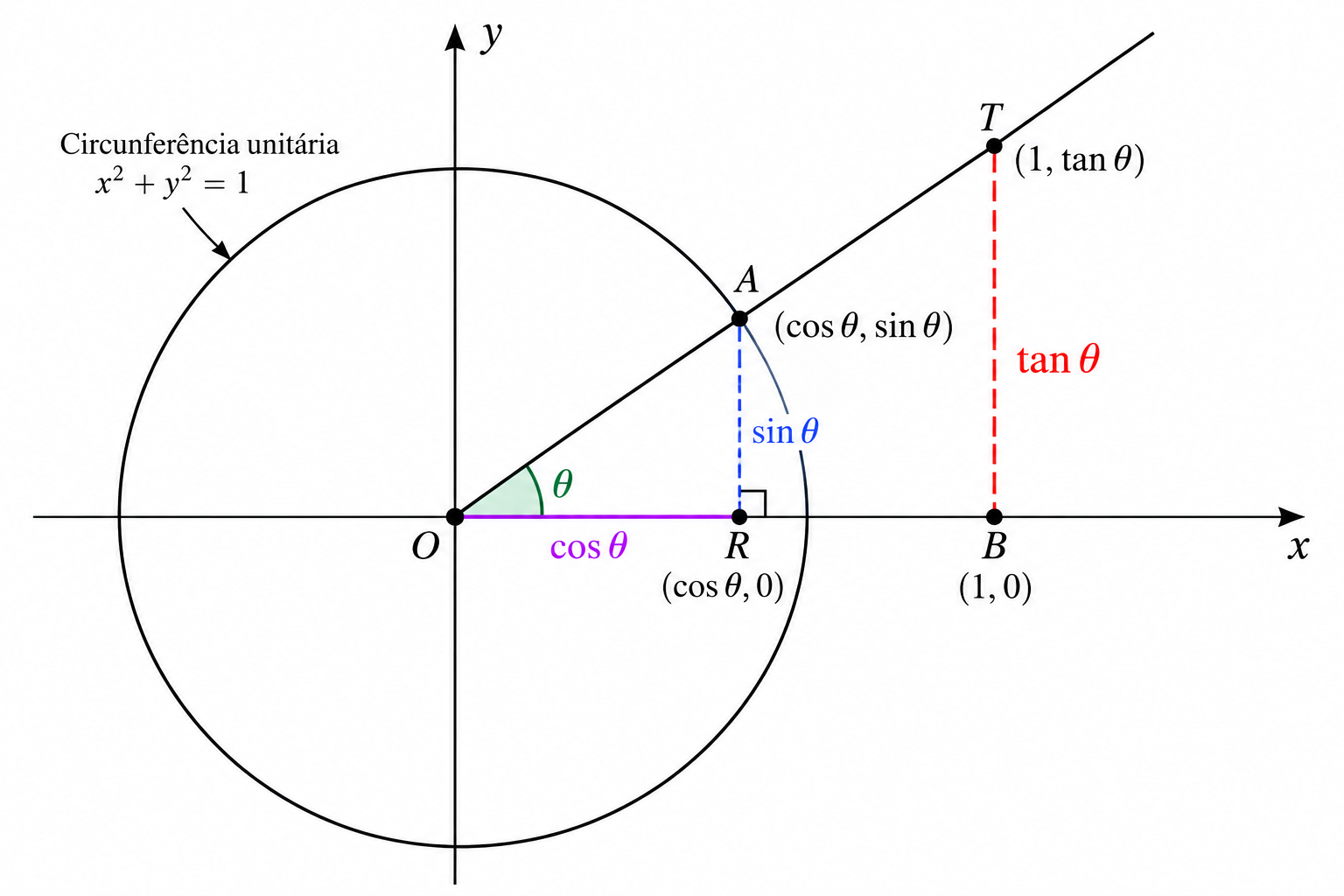
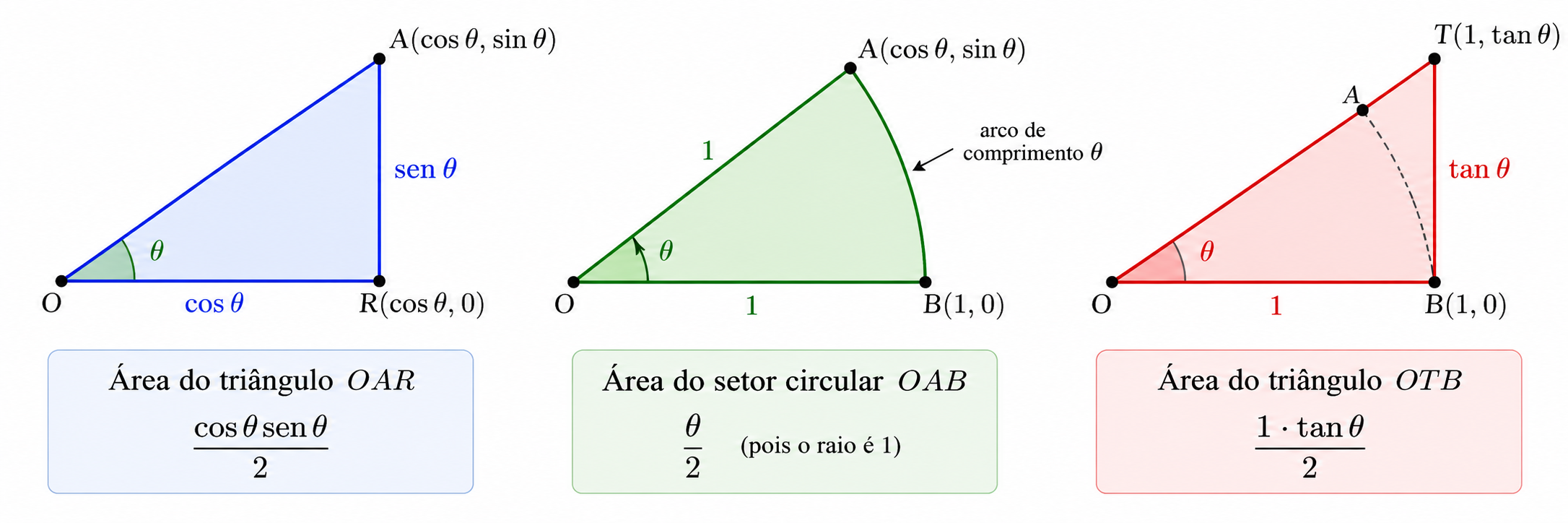
From the geometric interpretation of the sine and tangent functions on the unit circle, we have
By comparing the areas of the three geometric elements, we have
2cosθsinθ<2θ<2tanθ.
Since
0<θ<2π,
we have
sinθ>0andcosθ>0.
Dividing the entire inequality by
2sinθ,
we obtain
cosθ<sinθθ<cosθ1.
Since all quantities are positive, we can invert the inequalities. Thus,
cosθ1>θsinθ>cosθ.
Rearranging the terms,
cosθ<θsinθ<cosθ1.
On the other hand, from the initial inequality
sinθ<θ,
and since θ>0, we have
θsinθ<1.
Therefore,
cosθ<θsinθ<1.
Analyzing Negative Values
We also need to analyze what happens when θ approaches 0 from the left.
Consider
−2π<θ<0.
Then,
0<−θ<2π.
We can apply the inequality obtained previously to the number −θ:
cos(−θ)<−θsin(−θ)<1.
We know that cosine is an even function:
cos(−θ)=cosθ,
and sine is an odd function:
sin(−θ)=−sinθ.
Therefore,
−θsin(−θ)=−θ−sinθ=θsinθ.
Thus,
cosθ<θsinθ<1.
Therefore, the same inequality holds when
−2π<θ<0.
Consequently, for every θ such that
0<∣θ∣<2π,
we have
cosθ<θsinθ<1.
Letting θ Approach Zero
Now we can calculate the limit
θ→0limθsinθ.
We know that, for θ sufficiently close to 0, with θ=0,
cosθ<θsinθ<1.
Let's calculate the limits of the expressions that appear at the endpoints.
Since the cosine function is continuous,
θ→0limcosθ=cos0=1.
Furthermore,
θ→0lim1=1.
Therefore,
θ→0limcosθ=1=θ→0lim1.
Thus, we have
cosθ<θsinθ<1,
with both endpoints approaching 1 as θ→0.
By the Squeeze Theorem, we conclude that
θ→0limθsinθ=1.
Conclusion
We have geometrically demonstrated that
x→0limxsinx=1.
This result is known as the fundamental trigonometric limit.
It is important to note that the equality depends on using radians to measure angles.
From this limit, we can obtain several other important results, such as
x→0limxsin(ax)=a,
and
x→0limxtanx=1.
3. Consequence: x→0limsinxx
We know that
x→0limxsinx=1.
Taking the reciprocal:
x→0limsinxx=11.
Therefore,
x→0limsinxx=1
4. Example
Calculate
x→0limxsin(5x).
We want to make the fundamental limit appear.
We multiply and divide by 5:
xsin(5x)=55xsin(5x).
Therefore,
x→0limxsin(5x)=5x→0lim5xsin(5x).
Let
u=5x,
when x→0, we have u→0.
Thus,
x→0lim5xsin(5x)=1.
Therefore,
x→0limxsin(5x)=5
5. General Case
Similarly, for a constant a,
x→0limxsin(ax)=a
provided that a is constant.
Proof
We write
xsin(ax)=aaxsin(ax).
Therefore,
x→0limxsin(ax)=ax→0limaxsin(ax).
By the fundamental limit,
x→0limaxsin(ax)=1.
Therefore,
x→0limxsin(ax)=a
6. Fundamental Cosine Limit
Another important result is
x→0limx1−cosx=0
We can understand this result using a trigonometric identity.
We know that
1−cosx=2sin2(2x).
Then,
x1−cosx=x2sin2(2x).
We can write
x=22x.
Thus,
x1−cosx=2xsin2(2x).
Now we write:
2xsin2(2x)=sin(2x)2xsin(2x).
When x→0,
sin(2x)→0
and
2xsin(2x)→1.
Therefore,
x→0limx1−cosx=0
7. A Very Useful Result
We can obtain another important limit:
x→0limx21−cosx.
Using
1−cosx=2sin2(2x),
we have
x21−cosx=x22sin2(2x).
Since
x2=4(2x)2,
we obtain
x21−cosx=21[2xsin(2x)]2.
Applying the fundamental limit:
x→0lim2xsin(2x)=1.
Therefore,
x→0limx21−cosx=21
8. Tangent Limit
We can use
tanx=cosxsinx.
Thus,
xtanx=xcosxsinx.
Separating the factors:
xtanx=xsinx⋅cosx1.
When x→0,
xsinx→1
and
cosx→1.
Therefore,
x→0limxtanx=1
9. Example with the Tangent
Calculate
x→0limxtan(3x).
We write
xtan(3x)=33xtan(3x).
By the fundamental tangent limit,
x→0lim3xtan(3x)=1.
Therefore,
x→0limxtan(3x)=3
10. A Limit Involving Sine and Cosine
Consider
x→0lim2xsin(4x).
We can write
2xsin(4x)=24xsin(4x).
Thus,
x→0lim2xsin(4x)=2.
Therefore,
x→0lim2xsin(4x)=2
11. Attention to Indeterminate Forms
It is important not to confuse an indeterminate form with the value of the limit.
For example,
x→0limxsinx
produces, by direct substitution,
00.
However,
x→0limxsinx=1
Therefore,
00
does not mean that the limit is zero.
It simply means that direct substitution is not sufficient.
12. Summary of the Fundamental Limits
The most important results from this topic are:
x→0limxsinx=1
x→0limsinxx=1
x→0limx1−cosx=0
x→0limx21−cosx=21
x→0limxtanx=1
And, for a constant a,
x→0limxsin(ax)=a
and
x→0limxtan(ax)=a.
13. Strategy for Solving Trigonometric Limits
When encountering a limit involving trigonometric functions, try to transform the expression until one of the fundamental forms appears:
usinu
or
utanu.
For example:
xsin(5x)=55xsin(5x).
From there, we can directly apply
u→0limusinu=1.
This strategy will be frequently used in the study of derivatives.
14. Next Step
The fundamental limits allow us to move on to one of the central concepts of Differential Calculus:
The continuity of a function.
In the next topic, we will study what it means for a function to be continuous at a point and how to use limits to verify continuity.